Is this recruiter real?
There is an official way to check whether a recruiter is licensed. In practice it barely works — links are buried, one portal is staff-only, and the published list is over a year old. So here is the honest version: the three questions that settle it on their own, then every official registry with a note on whether it actually worked when we last opened it.
Step 1 — the three questions that settle it
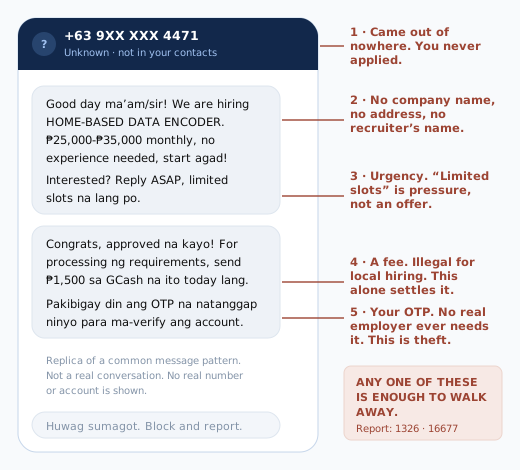
Any single “yes” here means stop. You do not need a registry to confirm this.
-
Are they asking you for money — in any form?
Placement fee, processing fee, training fee, “refundable” deposit, ID fee, uniform, medical paid to them, a load or GCash top-up. For local employment, charging a job seeker a placement fee is prohibited. For overseas work, licensed agencies cannot collect a placement fee before you have a signed employment contract, and for many destinations no fee is allowed at all.
No legitimate employer has ever needed your money to hire you. Walang exception dito.
-
Are they asking for an OTP, a PIN, or your bank or e-wallet login?
No employer, bank, or government agency needs these — ever. An OTP request is not a hiring step, it is a theft in progress. Related: if they want you to receive money and pass it on, or to open an account “for payroll,” that is money muling, and it is a crime you would be committing.
-
Did they contact you out of nowhere and refuse to name the company?
“We saw your profile” from a number you do not know, a Viber or Telegram group, or a Messenger account with no history — and no company name, no office address, no recruiter’s full name, no company email domain. A real employer will tell you who they are without being pushed. Scammers impersonate real brands, including JobStreet and DOLE itself, so a familiar name alone proves nothing.
Step 2 — verify, depending on the kind of job
If none of the three questions above tripped, now you check the registries. Which one depends on whether the work is overseas or local.
If the job is overseas
Overseas recruitment is regulated by the Department of Migrant Workers (DMW), which absorbed the old POEA. Here is each public route, with what we found when we opened it.
DMW public list of certified sending organisations Worked
Checked by hand · 24 October 2026
A genuinely public, searchable list. When we checked it showed 349 agencies with a reference code and a status of “Cleared.” No login needed.
The catch: this covers organisations certified as sending organisations, which is not the same thing as every licensed recruitment agency. An agency missing from this list is not automatically illegal — but one that is listed has at least been through DMW. Also, the dates in the table are not labelled, so you cannot tell whether a date is issue or expiry.
DMW “Licensed Recruitment Agencies” page Partly worked
Checked by hand · 24 October 2026
The page exists on the official domain, but the list itself is loaded by a script rather than published as plain text, so it can come up blank on a slow or data-saving connection. If it loads for you, use it. If you get an empty page, that is the page, not your phone.
DMW Advisory: List of Licensed Philippine Recruitment Agencies (PDF) Worked, but stale
Checked by hand · 24 October 2026
A downloadable PDF listing 334 agencies. It opens fine. But it is labelled “as of March 21, 2025” — more than eighteen months old at the time we checked. A licence can be suspended or cancelled in that time. Useful as a cross-check, not as proof.
verification.dmw.gov.ph Not for the public
Checked by hand · 24 October 2026
This one is worth being blunt about, because a lot of guides — including an earlier version of this site — told job seekers to go here. It is not a public lookup. It is a staff login screen for DMW personnel, and the page itself says accounts are issued only on a signed request from an office head. There is nothing here for a job seeker. Do not waste your data on it, and do not enter anything into it.
If the job is local
DOLE registry of local private employment agencies No public search found
Checked by hand · 24 October 2026
Local recruitment and placement needs a valid DOLE-issued Private Employment Agency (PEA) licence. We went looking for a public, searchable registry of those licences and could not find one. The Bureau of Local Employment does not appear to publish a lookup, and PhilJobNet states only that “only accredited employers may post job vacancies” — which tells you about postings on that site, not about the agency messaging you.
So for local work, the practical route is not a website. It is: call DOLE on 1349, or visit the DOLE regional or field office nearest you and ask them to confirm the agency’s PEA licence. Yes, that is worse than a search box. We would rather tell you that than send you round in circles.
PhilJobNet Worked
Checked by hand · 24 October 2026
DOLE’s own job board. Browsing vacancies works without an account; matching and employer contact details are account features. Because employers must be accredited to post, a vacancy appearing here is a mild positive signal — it is not a licence check.
Checking the company itself
SEC and DTI registration Could not open from our side
Checked by hand · 24 October 2026
Separately from any recruitment licence, you can ask whether the company legally exists. Corporations register with the SEC; sole proprietorships register a business name with the DTI. The SEC publishes a “SEC Check App” for phones that is the usual public route.
Being straight with you: we could not open either tool from our end on the date above, so we are not going to claim we tested them. Treat these as the right places to look rather than as links we have confirmed. If one of them works for you, that is a real signal — a company that cannot be found in either register, but is offering salaried jobs, is a serious problem.
Step 3 — watch the domain, not the design
Scam sites copy government branding well. What they cannot copy is the domain. Two rules:
.gov.ph. The DMW is dmw.gov.ph. DOLE is dole.gov.ph. CSC is csc.gov.ph. TESDA’s online courses are at e-tesda.gov.ph. Anything else — .com, .ph, .org, or a .gov.ph with extra words bolted on — is not the agency.dmwph.com, which is not the Department of Migrant Workers and carries no notice saying so. The same pattern exists for government forms: third-party “filler” sites rank well for things like the PDS, then paywall the download. Get forms from the agency, free.If you cannot verify, or it has already happened
Not being able to confirm an agency is not proof it is fake — the registries really are this patchy. But an offer you cannot verify, from someone who contacted you first, is not an offer worth risking money on.
A legitimate recruiter answers this in one message. A scammer gets annoyed, stalls, or disappears — and either way, you have your answer.
Report it
Reporting matters even if you lost nothing: in the most recent national survey only about 4% of scam encounters were reported at all, which is part of why this keeps working.
1326 — CICC 16677 — PNP ACG 1349 — DOLE
If money has already moved, contact your bank or e-wallet provider immediately as well — speed matters more than anything else at that stage. If you gave away an OTP, change the password on that account and any account sharing it.
Next
Run the offer through the checker
Twelve questions mapped to real fraud patterns, three of which settle it on their own. Runs entirely in your browser — nothing you type is sent anywhere or stored.
The full scam guide
The red flags in detail, the specific scam types running in the Philippines right now, and what to do at each stage if you are already in one.